Filter by
Political realism and the crisis of world politics: an American approach to f…
An interpretation based on the views of Reinhold Niebuhr, George F. Kennan, Walter Lippman, James Reston, etc.
- Edition
- -
- ISBN/ISSN
- 9781400878543
- Collation
- 261 p. 23 cm.
- Series Title
- -
- Call Number
- [POL-LIB-553]

We all lost the Cold War
Drawing on recently declassified documents and extensive interviews with Soviet and American policymakers, among them several important figures speaking for public record for the first time, Ned Lebow and Janice Stein cast new light on the effect of nuclear threats in two of the tensest moments of the Cold War: the Cuban Missile Crisis of 1962 and the several confrontations arising out of the A…
- Edition
- -
- ISBN/ISSN
- 0691033080
- Collation
- xiv, 542 p. ; 25 cm.
- Series Title
- Princeton studies in international history and politics
- Call Number
- [POL-SSS-68]
Security first : for a muscular, moral foreign policy
What should American policies be toward liberated countries such as Iraq and Afghanistan, or rogue states like North Korea and Iran? What must be done to protect America from nuclear terrorism? The author asserts that providing basic security must be the first priority in all foreign policy considerations, even ahead of efforts to democratize.
- Edition
- -
- ISBN/ISSN
- 9780300108576
- Collation
- 1 online resource (xviii, 308 p.)
- Series Title
- -
- Call Number
- [POL-SSS-48]
Security by other means : foreign assistance, global poverty, and American le…
"Assesses the current structures of foreign assistance and makes recommendations for efficient coordination. Drawing on expertise from the full range of foreign aid agencies, examines foreign assistance across four categories: security, economic, humanitarian, and political"--Provided by publisher.
- Edition
- -
- ISBN/ISSN
- 9780815713623
- Collation
- 1 online resource (xi, 364 p.) : ill., map.
- Series Title
- -
- Call Number
- [POL-SSS-42]

Multilateralism and security institutions in an era of globalization
Offers an examination of two of the most crucial and controversial issues in international relations - the evolution of particular concepts of multilateralism, and whether international security institutions are objects of state choice and/or consequential. This book combines a variety of theoretical perspectives with detailed empirical examples.
- Edition
- -
- ISBN/ISSN
- 0415449456
- Collation
- xiv, 370 p. : ill. ; 24 cm.
- Series Title
- -
- Call Number
- [POL-SSS-34]
A choice of enemies : America confronts the Middle East
Examines how the Camp David summit leading to the Israel-Egypt Treaty, the Iranian Islamic revolution, and the failed Soviet intervention in Afganistan all influenced America's strategic and policy choices and led to its current involvement in the MiddleEast.
- Edition
- 1st ed
- ISBN/ISSN
- 9781586485184
- Collation
- xxviii, 601 p. : maps ; 24 cm
- Series Title
- -
- Call Number
- [POL-SSS-01]
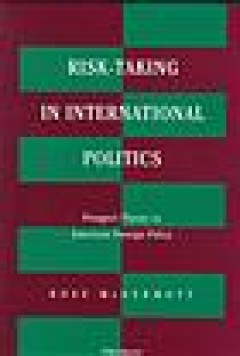
Risk-taking in international politics : prospect theory in American foreign p…
Risk plays a dramatic role in international relations as leaders make decisions about issues such as war and peace, disarmament, and about lowering economic barriers to trade and investment. How a country's leaders think about risk in making foreign policy decisions is important in understanding why and how they make decisions. Rose McDermott applies prospect theory to four cases in American fo…
- Edition
- -
- ISBN/ISSN
- 0472108670
- Collation
- x, 242 p. : ill. ; 24 cm.
- Series Title
- -
- Call Number
- [POL-IRT-54]
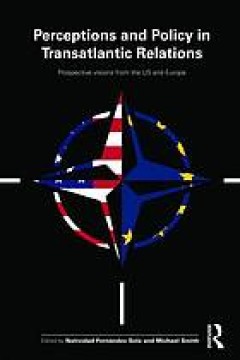
Perceptions and policy in transatlantic relations : prospective visions from …
Examines the tensions between Western Europe and the US over such issues as transatlantic security, policies towards terrorism and relations with Russia and the former Soviet Union, against the broader background of perceptions and misperceptions in transatlantic relations. This book is of interest to students of International Relations.
- Edition
- -
- ISBN/ISSN
- 0415454875
- Collation
- xiv, 216 p. : ill. ; 24 cm
- Series Title
- -
- Call Number
- [POL-IRT-46]
 Computer Science, Information & General Works
  Philosophy & Psychology
  Religion
  Social Sciences
  Language
  Pure Science
  Applied Sciences
  Art & Recreation
  Literature
  History & Geography