Filter by
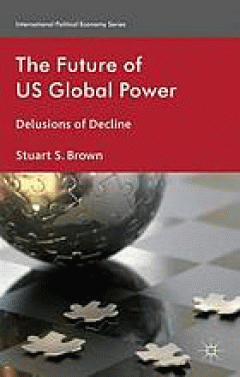
The future of US global power: delusions of decline
Has the combination of protracted war, explosive indebtedness and mounting income inequality dealt a decisive blow to US global influence and stature? Has the 'rise of the rest' completely upended the distribution of global power? The flood of recent commentary bemoaning the end of American primacy would lead one to think so. Stuart Brown rejects this conventional wisdom, and argues that the US…
- Edition
- -
- ISBN/ISSN
- 9781137023155
- Collation
- x, 321 p. : ill. ; 23 cm.
- Series Title
- International political economy series (Palgrave Macmillan (Firm))
- Call Number
- 327.730 090 512 BRO f

Strategy in the missile age
Strategy in the Missile Age was written during the dawn of the nuclear age, when the advent of intercontinental ballistic missiles necessitated a massive rethinking of military strategy and power. Originally published in 1959, it retains ample relevance today for its discussion of the origins of air power, its cornerstone position in the evolution of Cold War-era nuclear strategy, and its treat…
- Edition
- New RAND ed.
- ISBN/ISSN
- 9780833042248
- Collation
- xv, 423 p. ; 23 cm.
- Series Title
- -
- Call Number
- [POL-LIB-467]
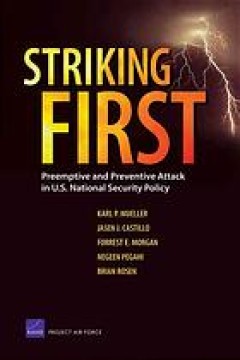
Striking first : preemptive and preventive attack in U.S. national security p…
RAND Project AIR FORCE studied the post-9/11 shift in US defense policy emphasis toward preemptive and preventive attack, asking under what conditions preemptive or preventive attack is worth considering as a response to perceived threats. It considered the role such first-strike strategies are likely to play in future US national security policy.
- Edition
- -
- ISBN/ISSN
- 0833038818
- Collation
- 1 online resource (xxxi, 311 p.)
- Series Title
- Rand Corporation monograph series
- Call Number
- [POL-SSS-62]

Strategy in the missile age
Reviews the development of modern military strategy to World War II, and considers new problems and new approaches. The study was undertaken by the Rand Corporation as a part of its research program for the United States Air Force.
- Edition
- -
- ISBN/ISSN
- 0691018529
- Collation
- vii, 423 p. 23 cm.
- Series Title
- Rand corporation.
- Call Number
- [POL-SSS-60]
Strategy and the social sciences : issues in defence policy
- Edition
- -
- ISBN/ISSN
- 0714631574
- Collation
- 1 online resource (100 p.)
- Series Title
- -
- Call Number
- [POL-SSS-56]
- Edition
- -
- ISBN/ISSN
- 0714631574
- Collation
- 1 online resource (100 p.)
- Series Title
- -
- Call Number
- [POL-SSS-56]
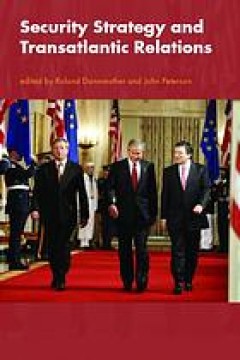
Security strategy and transatlantic relations
Tackles key questions such as: how much do security strategies signal convergence or divergence in US and EU foreign and security policy doctrine? What tangible political and policy impacts can be attributed to security strategies? What are the implications for US and EU policies towards specific regions?
- Edition
- -
- ISBN/ISSN
- 0415401909
- Collation
- xii, 262 p. ; 24 cm.
- Series Title
- -
- Call Number
- [POL-SSS-46]
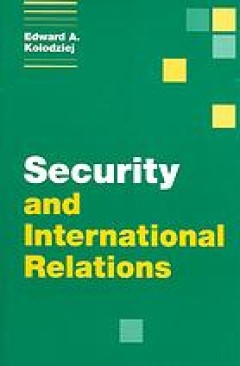
Security and international relations
Security studies as a branch of international relations theory is evaluated from the perspective of the main rival theories - realism, neorealism, liberal institutionalism, classic economic liberalism, and Marxism - to explain why international figures choose or eschew force and coercive threats in order to elicit favourable outcomes.
- Edition
- -
- ISBN/ISSN
- 9780521806435
- Collation
- xi, 349 p. ; 23 cm.
- Series Title
- Themes in international relations
- Call Number
- [POL-SSS-39]
 Computer Science, Information & General Works
  Philosophy & Psychology
  Religion
  Social Sciences
  Language
  Pure Science
  Applied Sciences
  Art & Recreation
  Literature
  History & Geography