Filter by
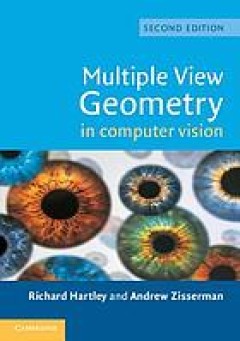
Multiple view geometry in computer vision
A basic problem in computer vision is to understand the structure of a real world scene given several images of it. Techniques for solving this problem are taken from projective geometry and photogrammetry. Here, the authors cover the geometric principles and their algebraic representation in terms of camera projection matrices, the fundamental matrix and the trifocal tensor. The theory and met…
- Edition
- 2nd ed.
- ISBN/ISSN
- 9780521540513
- Collation
- xvi, 655 p. : ill. (some col.) ; 25 cm.
- Series Title
- -
- Call Number
- 006.37 SZE c
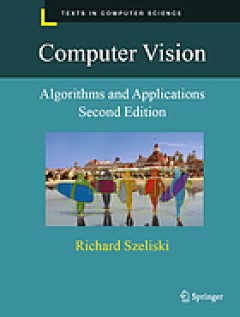
Computer vision: algorithms and applications
Computer Vision: Algorithms and Applications explores the variety of techniques used to analyze and interpret images. It also describes challenging real-world applications where vision is being successfully used, both in specialized applications such as image search and autonomous navigation, as well as for fun, consumer-level tasks that students can apply to their own personal photos and video…
- Edition
- -
- ISBN/ISSN
- 9783030343712
- Collation
- 1 online resource : illustrations (some color).
- Series Title
- -
- Call Number
- 006.37 SZE c
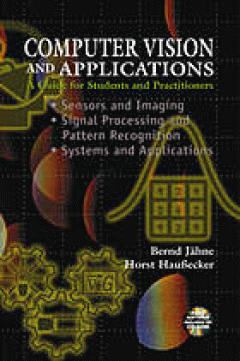
Computer vision and applications: a guide for students and practitioners
Based on the highly successful 3-volume reference Handbook of Computer Vision and Applications, this concise edition covers in a single volume the entire spectrum of computer vision ranging form the imaging process to high-end algorithms and applications. This book consists of three parts, including an application gallery, and is accompanied by an interactive CD-ROM. * Bridges the gap between t…
- Edition
- -
- ISBN/ISSN
- 9780123797773
- Collation
- xxi, 679 p. : ill. ; 23 cm. + 1 computer optical d
- Series Title
- -
- Call Number
- 006.37 JAH c
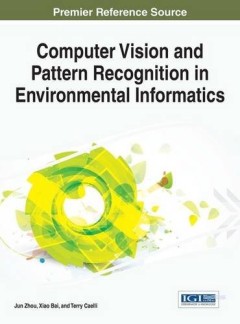
Computer vision and pattern recognition in environmental informatics
Jun Zhou, School of Information and Communication Technology, Griffith University, Australia, Xiao Bai, School of Computer Science and Engineering, Beihang University, China, and Terry Caelli, Department of Electrical and Electronic Engineering, the University of Melbourne, Australia, editors.
- Edition
- -
- ISBN/ISSN
- 9781466694354
- Collation
- xxvi, 407 pages : illustrations ; 29 cm
- Series Title
- Advances in environmental engineering and green technologies (AEEGT) book series
- Call Number
- [TLK-LIB-117]
 Computer Science, Information & General Works
  Philosophy & Psychology
  Religion
  Social Sciences
  Language
  Pure Science
  Applied Sciences
  Art & Recreation
  Literature
  History & Geography