Filter by
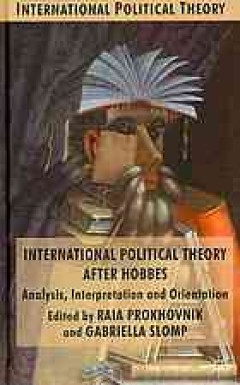
International political theory after Hobbes : analysis, interpretation and or…
The idea of international political theory after Hobbes is a timely and lively focus through which to raise questions about international politics. Contributors explore Hobbes' views on contemporary international political theory and on international relations in the context of the history of political thought and Hobbesian realism.
- Edition
- -
- ISBN/ISSN
- 9780230205383
- Collation
- x, 216 p. ; 23 cm.
- Series Title
- International political theory
- Call Number
- [POL-LIB-206]
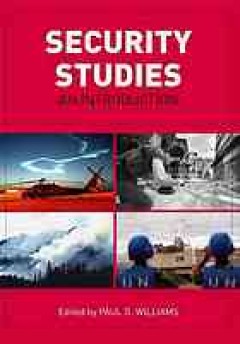
Security studies : an introduction
Gives students an overview of the major theoretical approaches, key themes and significant issues within security studies. This book explores the main theoretical approaches used within the field from realism to international political sociology. It explains the concepts underpinning contemporary debates from the security dilemma to terrorism.
- Edition
- -
- ISBN/ISSN
- 0415425611
- Collation
- xxiv, 552 p. : ill. ; 26 cm.
- Series Title
- -
- Call Number
- [POL-SSS-47]
Security communities
The contributors to this study argue that community can exist at the international level within the field of security. They suggest that security politics is profoundly shaped by a need to forge community links both contemporaneously and historically.
- Edition
- -
- ISBN/ISSN
- 0521630517
- Collation
- xiii, 462 p. ; 23 cm.
- Series Title
- Cambridge studies in international relations, 62
- Call Number
- [POL-SSS-44]
Security and international relations
Security studies as a branch of international relations theory is evaluated from the perspective of the main rival theories - realism, neorealism, liberal institutionalism, classic economic liberalism, and Marxism - to explain why international figures choose or eschew force and coercive threats in order to elicit favourable outcomes.
- Edition
- -
- ISBN/ISSN
- 9780521806435
- Collation
- xi, 349 p. ; 23 cm.
- Series Title
- Themes in international relations
- Call Number
- [POL-SSS-39]

New threats and new actors in international security
"Statistics show that today many more people are killed by ethnic conflicts, HIV/AIDS, or the proliferation of small arms than by international war. Moreover, non-state actors, such as non-governmental organizations, private military companies, and international regimes, are progressively complementing or even replacing states in the provision of security. Suggesting that such developments can …
- Edition
- -
- ISBN/ISSN
- 1403966974
- Collation
- xii, 230 p. ; 25 cm.
- Series Title
- -
- Call Number
- [POL-SSS-35]
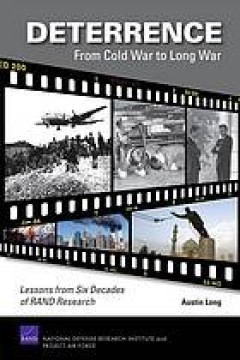
Deterrence : from Cold War to long war : lessons from six decades of Rand det…
Since its inception six decades ago, the RAND Corporation has been one of the key institutional homes for the study of deterrence. This book examines much of this research for lessons relevant to the current and future strategic environment. It is therefore part intellectual history and part policy recommendation, intended to encourage debate and discussion on how deterrence can best be incorpo…
- Edition
- -
- ISBN/ISSN
- 9780833044822
- Collation
- xiv, 107 p. ; 23 cm.
- Series Title
- -
- Call Number
- [POL-SSS-17]
Critical security studies : concepts and cases
Brings together a diverse new group of analysts seeking to explore issues of international relations and contribute to the development of a self-consciously critical perspective within security studies.
- Edition
- -
- ISBN/ISSN
- 0816628564
- Collation
- 1 online resource (xxiv, 379 p.)
- Series Title
- Borderlines (Minneapolis, Minn.), v. 8.
- Call Number
- [POL-SSS-14]

What moves man : the realist theory of international relations and its judgme…
The realist theory of international relations is based on a particularly gloomy set of assumptions about universal human motives. Believing people to be essentially asocial, selfish, and untrustworthy, realism counsels a politics of distrust and competition in the international arena. What Moves Man subjects realism to a broad and deep critique. Freyberg-Inan argues, first, that realist psychol…
- Edition
- -
- ISBN/ISSN
- 079145827X
- Collation
- vi, 266 p. ; 23 cm
- Series Title
- SUNY series in global politics
- Call Number
- [POL-IRT-72]
Two worlds of international relations : academics, practitioners and the trad…
In the twentieth century the social science of international relations has gone from strength to strength. At first, policy-makers showed little interest in academic international relations, but in the last thirty years they have both encouraged and to a degree intervened in this burgeoning field. For their part, academics have been drawn more and more into commentary on governments' actions, t…
- Edition
- -
- ISBN/ISSN
- 041506970X
- Collation
- xiii, 233 p. ; 22 cm
- Series Title
- -
- Call Number
- [POL-IRT-69]
Theories of international relations : transition vs. persistence
"This book is a synthetic historiography of present-day international relations theory. It is a critical analysis of the continuing diversity and complexity of enduring themes through a sustained focus on the analysis of the empirical evidence accumulated by social scientists. Special attention is given to key historical changes in theoretical approaches over the past half-century with full rec…
- Edition
- -
- ISBN/ISSN
- 0312230745
- Collation
- 317 p. ; 25 cm
- Series Title
- -
- Call Number
- [POL-IRT-65]
 Computer Science, Information & General Works
  Philosophy & Psychology
  Religion
  Social Sciences
  Language
  Pure Science
  Applied Sciences
  Art & Recreation
  Literature
  History & Geography