Filter by
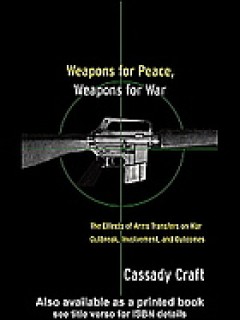
Weapons for peace, weapons for war : the effect of arms transfers on war outb…
Using innovative techniques, this book has the potential to change the way analysts weigh the impact of weapons sales.
- Edition
- -
- ISBN/ISSN
- 0415922585
- Collation
- 1 online resource (viii, 182 p.) : ill.
- Series Title
- -
- Call Number
- [POL-SSS-69]
We all lost the Cold War
Drawing on recently declassified documents and extensive interviews with Soviet and American policymakers, among them several important figures speaking for public record for the first time, Ned Lebow and Janice Stein cast new light on the effect of nuclear threats in two of the tensest moments of the Cold War: the Cuban Missile Crisis of 1962 and the several confrontations arising out of the A…
- Edition
- -
- ISBN/ISSN
- 0691033080
- Collation
- xiv, 542 p. ; 25 cm.
- Series Title
- Princeton studies in international history and politics
- Call Number
- [POL-SSS-68]

The ghost of Napoleon
B. H. Liddell Hart believes that "thought working on thought is the most influential process in history. Yet, being intangible, it is less perceptible than the effects of action, and has always received far less attention than it deserves." In THE GHOST OF NAPOLEON, Liddell Hart concentrates on two of these intellections, each of which vitally affected the course of history in the last two c…
- Edition
- -
- ISBN/ISSN
- 0313221723
- Collation
- 199 p. 21 cm.
- Series Title
- -
- Call Number
- [POL-SSS-64]
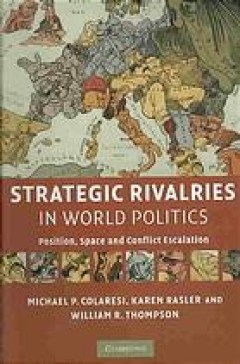
Strategic rivalries in world politics : position, space and conflict escalation
"International conflict is neither random nor inexplicable. It is highly structured by antagonisms between a relatively small set of states that regard each other as rivals. Examining the 173 strategic rivalries in operation throughout the nineteenth and twentieth centuries, this book identifies the differences rivalries make in the probability of conflict escalation and analyzes how they inter…
- Edition
- -
- ISBN/ISSN
- 9780521881340
- Collation
- xiv, 314 p. : ill. ; 23 cm.
- Series Title
- -
- Call Number
- [POL-SSS-51]
Security and post-conflict reconstruction : dealing with fighters in the afte…
This book provides a critical analysis of the changing discourse and practice of post-conflict security-promoting interventions since the Cold War.
- Edition
- -
- ISBN/ISSN
- 0415460549
- Collation
- xx, 291 p. : ill., map ; 24 cm.
- Series Title
- Routledge global security studies, 8.
- Call Number
- [POL-SSS-40]

Global instability and strategic crisis
The author seeks to bring new perspectives to current debates and argues that control of the missile threats cannot be achieved without addressing ecological, economic, social and cultural elements in a stable world order.
- Edition
- -
- ISBN/ISSN
- 041530413X
- Collation
- xix, 318 p. : ill. ; 25 cm.
- Series Title
- Routledge advances in international relations and politics, 26.
- Call Number
- [POL-SSS-25]
Dilemmas of nuclear strategy
Nuclear strategy and deterrence in their "golden age" -a nostalgically defined period sometime in the mid-1950s to mid-1960s - promised to harness and control the nuclear Moloch; hopes were high that the civilian strategists flooding into Washington would succeed in designing a new science of war that would safeguard national security, provide a stable international environment, and develop a r…
- Edition
- -
- ISBN/ISSN
- 0714632368
- Collation
- 1 online resource (131 p.) : ill.
- Series Title
- -
- Call Number
- [POL-SSS-19]
Deterrence now
This authoritative book examines the place of deterrence after the Cold War. Patrick Morgan explores the state of deterrence theory and its continuing relevance under conditions of nuclear proliferation, collective security organisations, and a revolution in military affairs. This book makes a significant contribution to strategic studies and international relations.
- Edition
- -
- ISBN/ISSN
- 9780521822572
- Collation
- 1 online resource (xx, 331 p.)
- Series Title
- Cambridge studies in international relations, 89.
- Call Number
- [POL-SSS-18]
Beyond fear : thinking sensibly about security in an uncertain world
Explains in detail, for example, why we need to design security systems that don't just work well, but fail well, and why secrecy on the part of government often undermines security.
- Edition
- -
- ISBN/ISSN
- 0387026207
- Collation
- 295 p. ; 24 cm
- Series Title
- -
- Call Number
- [POL-SSS-07]

Explaining war and peace : case studies and necessary condition counterfactuals
Containing essays by leading figures in the field, this volume focuses on the use of 'necessary condition counterfactuals' in explaining two key events in 20th century history, the start of the First World War and the end of the Cold War.
- Edition
- -
- ISBN/ISSN
- 0415422329
- Collation
- xvi, 346 p. ; 24 cm
- Series Title
- Contemporary security studies
- Call Number
- [POL-IRT-13]
 Computer Science, Information & General Works
  Philosophy & Psychology
  Religion
  Social Sciences
  Language
  Pure Science
  Applied Sciences
  Art & Recreation
  Literature
  History & Geography