Filter by

Customer relationship management : concepts and tools
and deliver value to targeted customers at a profit. Customer relationship management is grounded on high quality customer data and enabled by information technology. The book is a comprehensive and fully developed textbook on customer relationship management . Although, it shows the roles of customer data and information technology in enabling customer relationship management implementation, i…
- Edition
- -
- ISBN/ISSN
- 9780080472430
- Collation
- xviii, 359 p. ill. ; 25 cm.
- Series Title
- -
- Call Number
- [KOM-LIB-143]

Risk issues and crisis management in public relations: a casebook of best pra…
The reputation of an organization influences whether or not we buy from, work for, supply to and invest in that organization. This fourth edition of Risk Issues and Crisis Management in Public Relations defines reputation, explores how to value it, and provides practical guidelines for effectively managing it. This latest edition features new sections on the effects of recent world events, Corp…
- Edition
- 4th ed.
- ISBN/ISSN
- 9780749451073
- Collation
- xvii, 245 p. : ill. ; 24 cm.
- Series Title
- PR in practice series
- Call Number
- [KOM-LIB-137]

Systems thinking: managing chaos and complexity : a platform for designing bu…
In a global market economy, a viable business cannot be locked into a single form or function anymore. Rather, success is contingent upon a self-renewing capacity to spontaneously create structures, functions, and processes responsive to a fluctuating business landscape. Now in its third edition, Systems Thinking synthesizes systems theory and interactive design, providing an operational method…
- Edition
- 3rd ed.
- ISBN/ISSN
- 9780123859150
- Collation
- xxi, 351 p. : ill. ; 23 cm.
- Series Title
- -
- Call Number
- [POL-LIB-440]

Business process management: concepts, languages, architectures
- Edition
- 2nd ed.
- ISBN/ISSN
- 9783642286155
- Collation
- xv, 403 p. : ill. ; 24 cm.
- Series Title
- -
- Call Number
- [TIN-LIB-73]
- Edition
- 2nd ed.
- ISBN/ISSN
- 9783642286155
- Collation
- xv, 403 p. : ill. ; 24 cm.
- Series Title
- -
- Call Number
- [TIN-LIB-73]

Essentials of knowledge management
This is a very reader-friendly survey of Knowledge Management. KM is a business optimization strategy that identifies, selects, organizes, distills, and packages information essential to the business of a company. This book provides best practices in knowledge management, examines enabling technologies and discusses implementation issues. Highly recommended!
- Edition
- -
- ISBN/ISSN
- 9780471281139
- Collation
- xv, 208 p. : ill. ; 23 cm.
- Series Title
- Essentials series
- Call Number
- [TIN-LIB-107]

PROCEEDINGS International Conference on Management, Hospitality & Tourism, an…
The 2nd International Conference on Management, Hospitality & Tourism and Accounting is a significant contribution towards our commitment for quality research in Management, Hospitality & Tourism and Accounting and related areas. The theme of the conference is on Knowledge Management, Corporate Sustainability & Services in Global Competition addressed all the problems and issues that challenge …
- Edition
- -
- ISBN/ISSN
- 9789791878319
- Collation
- -
- Series Title
- -
- Call Number
- [PRO-TIN-008]
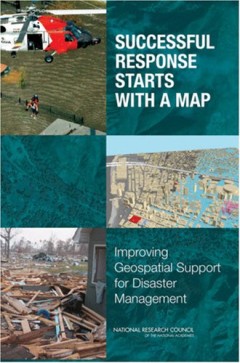
Successful response starts with a map: improving geospatial support for disas…
Committee on Planning for Catastrophe: a Blueprint for Improving Geospatial Data, Tools, and Infrastructure, Mapping Science Committee, Board on Earth Sciences and Resources, Division on Earth and Life Studies, National Research Council of the National Academies.
- Edition
- -
- ISBN/ISSN
- 9780309103404
- Collation
- xiv, 184 p. : col. ill., col. maps ; 23 cm.
- Series Title
- -
- Call Number
- [TIN-LIB-103]

Introduction to international disaster management
Offers practitioners, educators and students with a comprehensive overview of the players, processes and special issues involved in the management of large-scale natural and technological disasters. This book discusses special issues encountered in the management of international disasters.
- Edition
- -
- ISBN/ISSN
- 9780750679824
- Collation
- xxiii, 547 p. : ill. (chiefly col.), col. maps ; 2
- Series Title
- -
- Call Number
- [TIN-LIB-102]

The handbook of disaster and emergency policies and institutions
Disasters both natural and human-induced are leading to spiralling costs in terms of human lives, lost livelihoods and damaged assets and businesses. Yet these consequences and the financial and human crises that follow catastrophes can often be traced to policies unsuited to the emerging scales of the problems they confront, and the lack of institutional capacity to implement planning and prev…
- Edition
- -
- ISBN/ISSN
- 9781844073597
- Collation
- xvii, 187 p. : ill. ; 24 cm.
- Series Title
- -
- Call Number
- [TIN-LIB-101]

Geo-information for disaster management
Geo-information technology offers an opportunity to support disaster management: industrial accidents, road collisions, complex emergencies, earthquakes, fires, floods and similar catastrophes (for example the recent huge disaster with the Tsunami in South-East Asia on 26 December 2004). Access to needed information, facilitation of the interoperability of emergency services, and provision of h…
- Edition
- -
- ISBN/ISSN
- 3540249885
- Collation
- xxvi, 1434 p. : ill., maps ; 24 cm.
- Series Title
- -
- Call Number
- [TIN-LIB-100]
 Computer Science, Information & General Works
 Philosophy & Psychology
 Religion
 Social Sciences
 Language
 Pure Science
 Applied Sciences
 Art & Recreation
 Literature
 History & Geography