Filter by

Media and Communication Research Methods
This essential textbook provides a clear and authoritative introduction to qualitative and quantitative methods for studying media and communication. Written by two highly experienced researchers, the book draws on a wide range of media and communication research to introduce students to the relative strengths of the different research approaches. Beginning with an overview of the changing cont…
- Edition
- 2nd. Ed
- ISBN/ISSN
- 9781137528247
- Collation
- ix, 314 p. : ill. ; 24 cm.
- Series Title
- -
- Call Number
- 302.23 Han m

Oxford handbook of digital technology and society
This book is a guide into the increasingly interconnected domains of digital technology and society. It presents extensive reviews into several domains affected by digital technology and media, such as health, politics, and interpersonal relationships, which are developed from the findings of the "Ways of Being in a Digital Age" project commissioned by the UK Economic and Social Research Counci…
- Edition
- -
- ISBN/ISSN
- 9780190932596
- Collation
- xli, 756 pages : illustrations ; 26 cm
- Series Title
- -
- Call Number
- 303.4 YAT h

Understanding media: the extensions of man
This reissue marks the thirtieth anniversary (1964-1994) of McLuhan's classic expose on the state of the then emerging phenomenon of mass media. Terms and phrases such as "the global village" and "the medium is the message" are now part of the lexicon, and McLuhan's theories continue to challenge our sensibilities and our assumptions about how and what we communicate. There has been a notable r…
- Edition
- 1st.ed
- ISBN/ISSN
- 0262631598
- Collation
- xxiii, 365 p. ; 23 cm.
- Series Title
- -
- Call Number
- 302.23 McL U

Mediating the message in the 21st century: a media sociology perspective
This book offers a theoretical approach to media content in the twenty-first century, with an added focus on entertainment media and the Internet
- Edition
- 3rd ed.
- ISBN/ISSN
- 9780415989138
- Collation
- xix, 287 pages : illustrations ; 24 cm
- Series Title
- -
- Call Number
- 302.23 SHO m

Media sociology
- Edition
- -
- ISBN/ISSN
- 9780415051101
- Collation
- 1 online resource (138 pages) : illustrations
- Series Title
- -
- Call Number
- 302.2 BAR m
- Edition
- -
- ISBN/ISSN
- 9780415051101
- Collation
- 1 online resource (138 pages) : illustrations
- Series Title
- -
- Call Number
- 302.2 BAR m

Media & culture : mass communication in a digital age
Now, more than ever, media surround, enhance, and affect our everyday experiences. Navigating the converged worlds of text, audio, and visual media--and understanding how they fit together--can be challenging. "Media & Culture" recognizes these challenges and makes the media industries accessible in print and online. The new edition reflects the latest and most relevant changes to the digital m…
- Edition
- 12th.ed
- ISBN/ISSN
- 9781319102852
- Collation
- 1 volume (various pagings) : illustrations (some c
- Series Title
- -
- Call Number
- 302.230973 CAM m

Mass communication : living in a media world
Mass Communication: Living in a Media World" presents a highly accessible introduction to mass communication that equips students with the critical thinking skills they need to become savvy media consumers. To help students better retain the material, author Ralph E. Hanson uses a storytelling approach that weaves in examples drawn from everyday life. Readers are encouraged to consider the medi…
- Edition
- 8th.ed
- ISBN/ISSN
- 9781544382999
- Collation
- xxvii, 457 pages : illustrations ; 28 cm
- Series Title
- -
- Call Number
- 302.23 HAN m

Mass communications and media studies: an introduction
During a tumultuous period when financial speculation began rapidly to outpace industrial production and consumption, Victorian financial journalists commonly explained the instability of finance by criticizing its inherent artifice--drawing persistent attention to what they called "fictitious capital." In a shift that naturalized this artifice, this critique of fictitious capital virtually dis…
- Edition
- 2nd ed
- ISBN/ISSN
- 9781501329982
- Collation
- viii, 321pages : illustrations ; 23 cm
- Series Title
- -
- Call Number
- 302.23 PAX m

Dictionary of media and communication studies
The Dictionary of Media and Communication Studies has provided students and the general public alike with a gateway into the study of intercultural communication, public relations and marketing communications since 1984. In this 9th edition, James Watson and Anne Hill provide a detailed compendium of the different facets of personal, group, mass-media and internet communication that continues t…
- Edition
- 9th ed
- ISBN/ISSN
- 9781628921489
- Collation
- xxvi, 373 pages : illustrations ; 23 cm
- Series Title
- -
- Call Number
- 302.203 WAT d
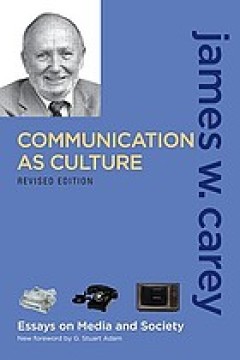
Communication as culture: essays on media and society
In this classic text, James W. Carey maintains that communication is not merely the transmission of information. Reminding the reader of the link between the words "communication" and "community," he broadens his definition to include the drawing-together of a people that is culture. In this context, Carey questions the American tradition of focusing only on mass communication's function as a m…
- Edition
- Rev. ed.
- ISBN/ISSN
- 9780415989756
- Collation
- xxvii, 205 p. ; 23 cm.
- Series Title
- -
- Call Number
- 302.23 CAR c
 Computer Science, Information & General Works
 Philosophy & Psychology
 Religion
 Social Sciences
 Language
 Pure Science
 Applied Sciences
 Art & Recreation
 Literature
 History & Geography