Filter by
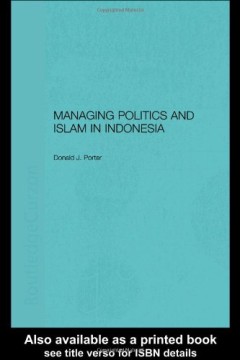
Managing politics and Islam in Indonesia
This book examines the politics of Islam and the state in Indonesia over recent decades, during which time there has been a notable resurgence of Islamic political movements. It argues that after a period when the state worked to bring religious authority and institutions within state- prescribed limits in order to support the official state ideology and political stability, in the late 1980s a…
- Edition
- -
- ISBN/ISSN
- 0700717366
- Collation
- xxi, 264 p. ; 25 cm.
- Series Title
- -
- Call Number
- [POL-LIB-416]
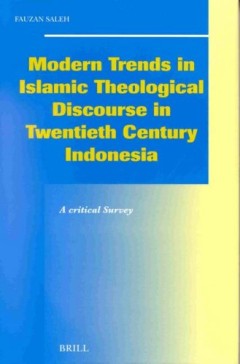
Modern trends in Islamic theological discourse in 20th century Indonesia: a c…
This work traces the development of 20th century Islamic theological discourse in Indonesia, focussing on how modernist Muslims have constructed their theological thought during this period, which, in turn, reflects their religious understanding in response to the particular demands of their age
- Edition
- -
- ISBN/ISSN
- 9004123059
- Collation
- xvi, 343 p. ; 25 cm.
- Series Title
- Social, economic, and political studies of the Middle East and Asia, v. 79
- Call Number
- [POL-LIB-414]
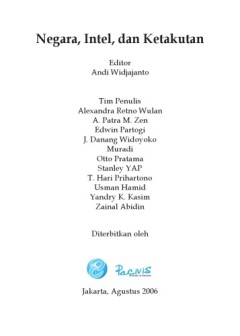
Negara, intel, dan ketakutan
tim penulis, Alexandra Retno Wulan ... [et al.] ; editor, Andi Widjajanto.
- Edition
- Cet. 1.
- ISBN/ISSN
- 9792521623
- Collation
- viii, 343 p. : ill. ; 22 cm.
- Series Title
- -
- Call Number
- [POL-LIB-412]
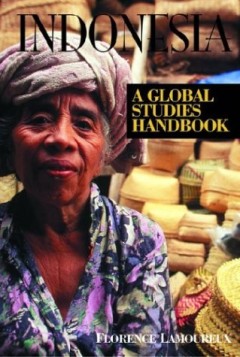
Indonesia : a global studies handbook
Examines the history, geography, politics, religion, economy, and culture of the fourth-most populous country in the world.
- Edition
- -
- ISBN/ISSN
- 1576079139
- Collation
- xviii, 251 p. : ill., maps ; 24 cm.
- Series Title
- Global studies., Asia.
- Call Number
- [POL-LIB-229]
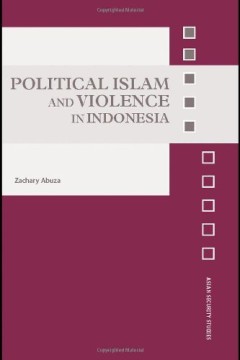
Political Islam and violence in Indonesia
- Edition
- 1st ed.
- ISBN/ISSN
- 9780415394017
- Collation
- ix, 162 p. ; 24 cm.
- Series Title
- Asian security studies
- Call Number
- [POL-LIB-411]
- Edition
- 1st ed.
- ISBN/ISSN
- 9780415394017
- Collation
- ix, 162 p. ; 24 cm.
- Series Title
- Asian security studies
- Call Number
- [POL-LIB-411]
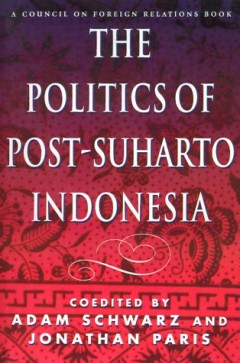
The politics of post-Suharto Indonesia
Responding to the critical need of policymakers, and practitioners for current research on Indonesia, this text focuses on four areas: the economy; religion and ethnicitiy; civil society; and the military. A concluding chapter covers the International Monetary Fund and US policy towards Indonesia.
- Edition
- -
- ISBN/ISSN
- 9780876092477
- Collation
- ix, 120 p. ; 23 cm.
- Series Title
- -
- Call Number
- [POL-LIB-410]
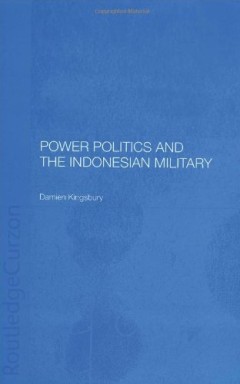
Power politics and the Indonesian military
Throughout the postwar history of Indonesia, the military have played a key role in the politics of the country and in imposing unity on a fragmentary state. The collapse of the authoritarian New Order government of President Suharto weakened the state and the armed forces briefly lost their grip on control of the archipelago. However, under President Megawati, the military has again begun to a…
- Edition
- -
- ISBN/ISSN
- 041529729X
- Collation
- xviii, 280 p. ; 25 cm.
- Series Title
- -
- Call Number
- [POL-LIB-409]
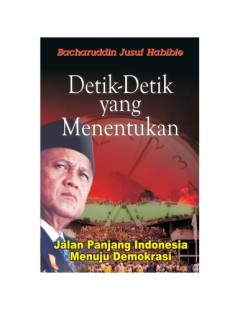
Detik-detik yang menentukan: jalan panjang Indonesia menuju demokrasi
Bacharuddin Jusuf Habibie.
- Edition
- Cet. 1.
- ISBN/ISSN
- 979993866X
- Collation
- vi, 549 p. : col. ill. ; 22 cm.
- Series Title
- -
- Call Number
- [POL-LIB-406]

Poster Film Indonesia : Era teknologi komputer grafis
- Edition
- -
- ISBN/ISSN
- 9789790084643
- Collation
- x,109 p. ; ilus : 28cm
- Series Title
- -
- Call Number
- [KOM-LIB-101]
- Edition
- -
- ISBN/ISSN
- 9789790084643
- Collation
- x,109 p. ; ilus : 28cm
- Series Title
- -
- Call Number
- [KOM-LIB-101]

East Timor, Australia and regional order: intervention and its aftermath in S…
This book explains the exceptional nature of the East Timor intervention of 1999, and deals with the background to the trusteeship role of the UN in building the new polity. All of these developments had an important impact on regional order, not least testing the ASEAN norm of 'non-interference'.Australian complicity in the Indonesian occupation of East Timor was a major factor in the persiste…
- Edition
- -
- ISBN/ISSN
- 0415335809
- Collation
- xii, 193 p. ; 25 cm.
- Series Title
- Politics in Asia series
- Call Number
- [POL-ASEA-05]
 Computer Science, Information & General Works
  Philosophy & Psychology
  Religion
  Social Sciences
  Language
  Pure Science
  Applied Sciences
  Art & Recreation
  Literature
  History & Geography