Filter by

Climate change and disaster risk management
There has been some degree of reluctance in the past to consider disaster risk management within the mainstream of adaptation to climate variability and climate change. However, there is now wide recognition of the need to incorporate disaster risk management concerns in dealing with such phenomena. There is also a growing awareness of the necessity for a multi-sectoral approach in managing …
- Edition
- -
- ISBN/ISSN
- 9783642311093
- Collation
- xii, 692 pages : illustrations (some color), maps
- Series Title
- Climate change management (Springer (Firm))
- Call Number
- [TLK-LIB-138]

Geographic information systems (GIS) for disaster management
Provides coverage of the basics of GIS. It examines what GIS can and can't do, GIS data formats (vector, raster, imagery), and basic GIS functions including analysis, map production/cartography, and data modeling. It presents a series of real-life case studies that illustrate the GIS concepts discussed in each chapter. These case studies supply readers with an understanding of the applicability…
- Edition
- -
- ISBN/ISSN
- 9781482211689
- Collation
- xv, 295 pages ; 27 cm
- Series Title
- -
- Call Number
- [TLK-LIB-136]
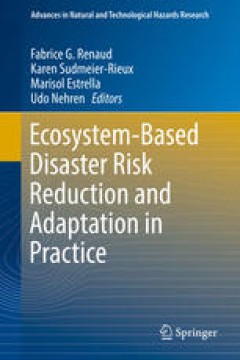
Ecosystem-based disaster risk reduction and adaptation in practice
This book is a compilation of recent developments in the field of ecosystem-based disaster risk reduction and climate change adaption (Eco-DRR/CCA) globally. It provides further evidence that ecosystem-based approaches make economic sense, and showcases how research has progressively filled knowledge gaps about translating this concept into practice. It presents a number of methods, and tools t…
- Edition
- -
- ISBN/ISSN
- 9783319436333
- Collation
- 1 online resource.
- Series Title
- Advances in natural and technological hazards research, v. 42.
- Call Number
- [TLK-LIB-135]
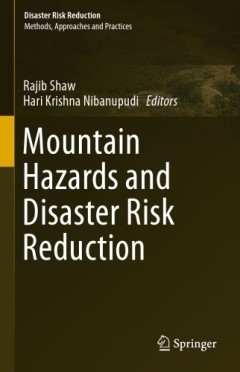
Mountain hazards and disaster risk reduction
The Hindu Kush Himalayan (HKH) region is highly vulnerable to earthquakes and water-induced disasters. This fragile mountain region is under tremendous stress from climate change and land-use degradation that has accelerated flash floods, river-line floods, erosion, and wet mass movements during the monsoon period and drought in the non-monsoon period. Against the backdrop of intensifying disas…
- Edition
- -
- ISBN/ISSN
- 9784431552413
- Collation
- xi, 284 pages : illustrations (some color), maps
- Series Title
- Disaster risk reduction
- Call Number
- [TLK-LIB-134]

Environmental health in emergencies and disasters: a practical guide
- Edition
- -
- ISBN/ISSN
- 9789241545419
- Collation
- xx, 252 p. : ill. ; 30 cm.
- Series Title
- -
- Call Number
- [TLK-LIB-133]
- Edition
- -
- ISBN/ISSN
- 9789241545419
- Collation
- xx, 252 p. : ill. ; 30 cm.
- Series Title
- -
- Call Number
- [TLK-LIB-133]

Environmental Project Management: Principles, Methodology, and Processes
It is unique in that it clearly distinguishes between environmental project management (EnvPM) and green project management (GreenPM), and presents an amalgamation of environmental management and project management concepts, using geospatial methods to form an EnvPM concept
- Edition
- -
- ISBN/ISSN
- 9783319276496
- Collation
- pages cm
- Series Title
- Environmental science and engineering (Springer (Firm))., Environmental science.
- Call Number
- [TLK-LIB-130]

Ideas in marketing : finding the new and polishing the old : proceedings of t…
- Edition
- -
- ISBN/ISSN
- 9783319109510
- Collation
- 1 online resource (lxv, 842 pages).
- Series Title
- -
- Call Number
- PRO-037
- Edition
- -
- ISBN/ISSN
- 9783319109510
- Collation
- 1 online resource (lxv, 842 pages).
- Series Title
- -
- Call Number
- PRO-037
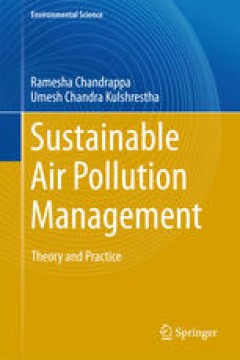
Sustainable air pollution management : theory and practice
This work is intended as a textbook on the theory and practice of sustainable air pollution management. The book discusses the fundamental aspects of traditional air pollution topics as well as some more advanced topics (such as atmospheric brown cloud, trans-boundary movement of air pollutants, air transportation of radioactive material, biological air pollutants, etc.). Though much has been w…
- Edition
- -
- ISBN/ISSN
- 9783319215952
- Collation
- -
- Series Title
- Environmental science and engineering (Springer (Firm))., Environmental science.
- Call Number
- [TLK-LIB-119]

Statistics for managers using Microsoft Excel
- Edition
- 8th ed
- ISBN/ISSN
- 9781292156347
- Collation
- xxii, 699 pages : illustrations (chiefly color) ;
- Series Title
- -
- Call Number
- [MNJ-LIB-109]
- Edition
- 8th ed
- ISBN/ISSN
- 9781292156347
- Collation
- xxii, 699 pages : illustrations (chiefly color) ;
- Series Title
- -
- Call Number
- [MNJ-LIB-109]
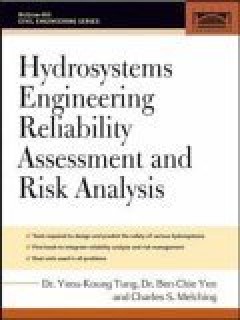
Hydrosystems engineering reliability assessment and risk analysis
This is the first book to integrate reliability analysis and risk assessment with the planning, design, and management of hydrosystems (dams, levees, storm sewers, etc.). Requiring only a basic knowledge of probability and statistics, readers will be able to determine how hydrosystem structures will perform under various circumstances.
- Edition
- -
- ISBN/ISSN
- 9780071451581
- Collation
- xvi, 495 p. : ill. ; 25 cm.
- Series Title
- McGraw-Hill civil engineering
- Call Number
- [TSI-LIB-187]
 Computer Science, Information & General Works
 Philosophy & Psychology
 Religion
 Social Sciences
 Language
 Pure Science
 Applied Sciences
 Art & Recreation
 Literature
 History & Geography