Filter by

International political theory after Hobbes : analysis, interpretation and or…
The idea of international political theory after Hobbes is a timely and lively focus through which to raise questions about international politics. Contributors explore Hobbes' views on contemporary international political theory and on international relations in the context of the history of political thought and Hobbesian realism.
- Edition
- -
- ISBN/ISSN
- 9780230205383
- Collation
- x, 216 p. ; 23 cm.
- Series Title
- International political theory
- Call Number
- [POL-LIB-206]
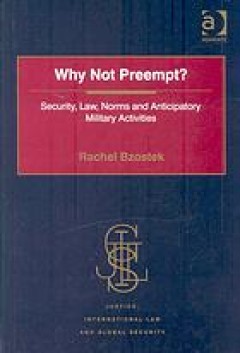
Why not preempt? : security, law, norms and anticipatory military activities
Anticipatory military activities, both preemptive and preventive, are at the centre of American strategic doctrine. Rachel Bzostek puts forward a full understanding of why states have or have not undertaken such activities in the past in order to comprehend why states have rarely used this method.
- Edition
- -
- ISBN/ISSN
- 9780754670575
- Collation
- 1 online resource (viii, 258 p.)
- Series Title
- Justice, international law and global security
- Call Number
- [POL-SSS-73]
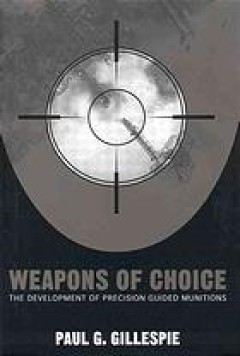
Weapons of choice : the development of precision guided munitions
“A significant addition to the field, for there are not many books specifically devoted to PGMs and still fewer that attempt to relate that technology to military and national security strategy.”—David R. Mets, author of The Long Search for a Surgical Strike: Precision Munitions and the Revolution in Military Affairs
- Edition
- -
- ISBN/ISSN
- 9780817315320
- Collation
- 1 online resource (xii, 218 p.) : ill.
- Series Title
- -
- Call Number
- [POL-SSS-70]

The ghost of Napoleon
B. H. Liddell Hart believes that "thought working on thought is the most influential process in history. Yet, being intangible, it is less perceptible than the effects of action, and has always received far less attention than it deserves." In THE GHOST OF NAPOLEON, Liddell Hart concentrates on two of these intellections, each of which vitally affected the course of history in the last two c…
- Edition
- -
- ISBN/ISSN
- 0313221723
- Collation
- 199 p. 21 cm.
- Series Title
- -
- Call Number
- [POL-SSS-64]
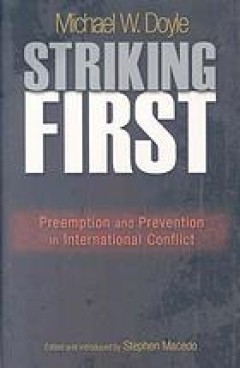
Striking first : preemption and prevention in international conflict
Tackling one of the most controversial policy issues of the post-September 11 world, this title argues that neither the Bush Doctrine nor customary international law is capable of adequately responding to the pressing security threats of our times.
- Edition
- -
- ISBN/ISSN
- 9780691136585
- Collation
- xxiv, 175 p. ; 23 cm.
- Series Title
- University Center for Human Values series
- Call Number
- [POL-SSS-63]
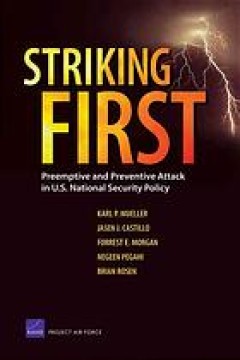
Striking first : preemptive and preventive attack in U.S. national security p…
RAND Project AIR FORCE studied the post-9/11 shift in US defense policy emphasis toward preemptive and preventive attack, asking under what conditions preemptive or preventive attack is worth considering as a response to perceived threats. It considered the role such first-strike strategies are likely to play in future US national security policy.
- Edition
- -
- ISBN/ISSN
- 0833038818
- Collation
- 1 online resource (xxxi, 311 p.)
- Series Title
- Rand Corporation monograph series
- Call Number
- [POL-SSS-62]

Strategy for chaos : revolutions in military affairs and the evidence of history
"In Strategy for Chaos, Professor Colin Gray develops and applies the theory and scholarship on the allegedly historical practice of the 'Revolution in Military Affairs' (RMA), in order to improve our comprehension of how and why strategy 'works'." "This is a brilliantly researched and thought-provoking book by one of the key thinkers in the field, and will be essential reading for all scholars…
- Edition
- -
- ISBN/ISSN
- 071468483X
- Collation
- xvi, 310 p. : ill. ; 25 cm.
- Series Title
- Cass series--strategy and history, 2.
- Call Number
- [POL-SSS-59]

Strategy and the social sciences : issues in defence policy
- Edition
- -
- ISBN/ISSN
- 0714631574
- Collation
- 1 online resource (100 p.)
- Series Title
- -
- Call Number
- [POL-SSS-56]
- Edition
- -
- ISBN/ISSN
- 0714631574
- Collation
- 1 online resource (100 p.)
- Series Title
- -
- Call Number
- [POL-SSS-56]

Security first : for a muscular, moral foreign policy
What should American policies be toward liberated countries such as Iraq and Afghanistan, or rogue states like North Korea and Iran? What must be done to protect America from nuclear terrorism? The author asserts that providing basic security must be the first priority in all foreign policy considerations, even ahead of efforts to democratize.
- Edition
- -
- ISBN/ISSN
- 9780300108576
- Collation
- 1 online resource (xviii, 308 p.)
- Series Title
- -
- Call Number
- [POL-SSS-48]

The action research dissertation: a guide for students and faculty
- Edition
- -
- ISBN/ISSN
- 0761929908
- Collation
- xvii, 155 p. ; 24 cm.
- Series Title
- -
- Call Number
- [KOM-LIB-108]
- Edition
- -
- ISBN/ISSN
- 0761929908
- Collation
- xvii, 155 p. ; 24 cm.
- Series Title
- -
- Call Number
- [KOM-LIB-108]
 Computer Science, Information & General Works
  Philosophy & Psychology
  Religion
  Social Sciences
  Language
  Pure Science
  Applied Sciences
  Art & Recreation
  Literature
  History & Geography