Filter by
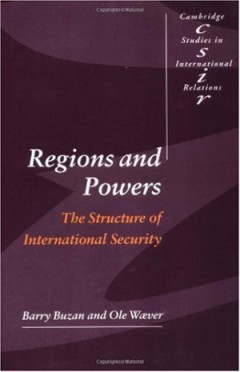
Regions and powers: the structure of international security
This book outlines a theory which in the post-Cold War era builds upon Waltz's neorealism theory of International Relations. Using this theory as a lens to examine the world of International Relationswill aid in one's understanding of the world we live in today. This is required reading for any one taking political science or IR at the graduate level. This book develops the idea that, since de…
- Edition
- -
- ISBN/ISSN
- 9780521891110
- Collation
- xxiv, 564 p. : ill., maps ; 24 cm.
- Series Title
- Cambridge studies in international relations
- Call Number
- 327.116 BUZ r

Leashing the dogs of war : conflict management in a divided world
- Edition
- -
- ISBN/ISSN
- 9781929223961
- Collation
- xviii, 726 pages : illustrations ; 26 cm
- Series Title
- -
- Call Number
- -
- Edition
- -
- ISBN/ISSN
- 9781929223961
- Collation
- xviii, 726 pages : illustrations ; 26 cm
- Series Title
- -
- Call Number
- -

International relations and world politics
Updated in its 5th edition, International Relations and World Politics is a toolkit that offers an authoritative survey of the field and practical ways to analyze current and future world problems. Drawn from the authors’ experience as scholars and practitioners, this new edition was completely rewritten to focus on an enduring teaching and learning goal–how individuals can apply theory, hi…
- Edition
- 5th ed.
- ISBN/ISSN
- 9780205854646
- Collation
- xvi, 550 p. : ill., maps ; 24 cm.
- Series Title
- -
- Call Number
- [POL-LIB-524]
Seeing the invisible: national security intelligence in an uncertain age
Intelligence is critical to ensuring national security, especially with asymmetric threats making up most of the new challenges. Knowledge, rather than power, is the only weapon that can prevail in a complex and uncertain environment awash with asymmetric threats, some known, many currently unknown. This book shows how such a changing national security environment has had profound implications …
- Edition
- -
- ISBN/ISSN
- 9789812704825
- Collation
- xvi, 246 p. : ill. ; 23 cm.
- Series Title
- -
- Call Number
- [POL-LIB-542]

Security first : for a muscular, moral foreign policy
What should American policies be toward liberated countries such as Iraq and Afghanistan, or rogue states like North Korea and Iran? What must be done to protect America from nuclear terrorism? The author asserts that providing basic security must be the first priority in all foreign policy considerations, even ahead of efforts to democratize.
- Edition
- -
- ISBN/ISSN
- 9780300108576
- Collation
- 1 online resource (xviii, 308 p.)
- Series Title
- -
- Call Number
- [POL-SSS-48]
Security studies : an introduction
Gives students an overview of the major theoretical approaches, key themes and significant issues within security studies. This book explores the main theoretical approaches used within the field from realism to international political sociology. It explains the concepts underpinning contemporary debates from the security dilemma to terrorism.
- Edition
- -
- ISBN/ISSN
- 0415425611
- Collation
- xxiv, 552 p. : ill. ; 26 cm.
- Series Title
- -
- Call Number
- [POL-SSS-47]
Security communities
The contributors to this study argue that community can exist at the international level within the field of security. They suggest that security politics is profoundly shaped by a need to forge community links both contemporaneously and historically.
- Edition
- -
- ISBN/ISSN
- 0521630517
- Collation
- xiii, 462 p. ; 23 cm.
- Series Title
- Cambridge studies in international relations, 62
- Call Number
- [POL-SSS-44]
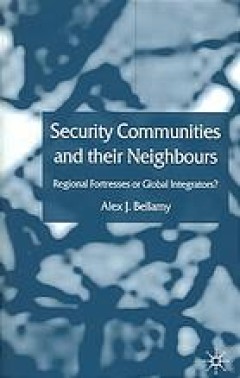
Security communities and their neighbours : regional fortresses or global int…
There are two types of security community: those that create a political community between themselves by institution building (such as the EU); and those that are pluralistic and are aligned through shared values, responsiveness to each others needs and policy goals by their political elites (such as the UK and Ireland or the USA and Canada). Bellamy seeks to examine the impact of the developme…
- Edition
- -
- ISBN/ISSN
- 140390622X
- Collation
- x, 221 p. ; 23 cm.
- Series Title
- Security communities and their neighbors
- Call Number
- [POL-SSS-43]
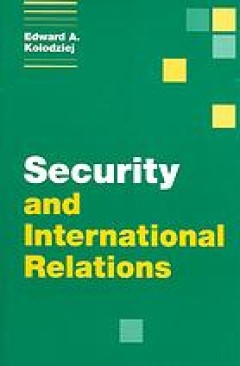
Security and international relations
Security studies as a branch of international relations theory is evaluated from the perspective of the main rival theories - realism, neorealism, liberal institutionalism, classic economic liberalism, and Marxism - to explain why international figures choose or eschew force and coercive threats in order to elicit favourable outcomes.
- Edition
- -
- ISBN/ISSN
- 9780521806435
- Collation
- xi, 349 p. ; 23 cm.
- Series Title
- Themes in international relations
- Call Number
- [POL-SSS-39]

New threats and new actors in international security
"Statistics show that today many more people are killed by ethnic conflicts, HIV/AIDS, or the proliferation of small arms than by international war. Moreover, non-state actors, such as non-governmental organizations, private military companies, and international regimes, are progressively complementing or even replacing states in the provision of security. Suggesting that such developments can …
- Edition
- -
- ISBN/ISSN
- 1403966974
- Collation
- xii, 230 p. ; 25 cm.
- Series Title
- -
- Call Number
- [POL-SSS-35]
 Computer Science, Information & General Works
  Philosophy & Psychology
  Religion
  Social Sciences
  Language
  Pure Science
  Applied Sciences
  Art & Recreation
  Literature
  History & Geography