Filter by
Environmental economics and natural resource management
Building a foundation, the big picture. Efficiency and choice, cost benefit analysis, supply and demand, summary, problems for review, internet resources, further reading. Market failure. The role o government. Environmental quality. Sustainability
- Edition
- 4th ed
- ISBN/ISSN
- 9780415640961
- Collation
- xviii, 428 pages ; 26 cm
- Series Title
- -
- Call Number
- 333.7 AND e
Plan B 3.0: mobilizing to save civilization
Brown's contemporary plan for saving human civilization is a "MUST READ" on the primary reading source for my doctoral International Communications course. My environmentalist-professor sensed that we not only hadn't read this book but that we didn't care enough about the frightening discoveries that each chapter of the book brings to the surface of the reader's mind. Just the chapter alone on …
- Edition
- 1st ed.
- ISBN/ISSN
- 9780393330878
- Collation
- xiv, 398 p. : ill. ; 24 cm.
- Series Title
- -
- Call Number
- [TLK-LIB-207]
Valuing environmental and natural resources : the econometrics of non-market …
Non-market valuation has become a broadly accepted and widely practised means of measuring the economic values of the environment and natural resources. This book provides a guide to the statistical and econometric practices that economists employ in estimating non-market values.
- Edition
- -
- ISBN/ISSN
- 9781843763888
- Collation
- 1 online resource (xvi, 326 pages) : illustrations
- Series Title
- New horizons in environmental economics.
- Call Number
- [TLK-LIB-190]
Energy, natural resources and environmental economics
The book consists of a collection of articles (survey and research) describing the area of energy, natural resources and environmental economics. The contents of the book is divided into four sections. The first part considers petroleum and natural gas applications, taking up topics ranging from the management of incomes and reserves to market modeling and value chain optimization. The second a…
- Edition
- -
- ISBN/ISSN
- 9783642120671
- Collation
- xviii, 521 p. : ill. ; 24 cm.
- Series Title
- Energy systems
- Call Number
- [TLK-LIB-145]
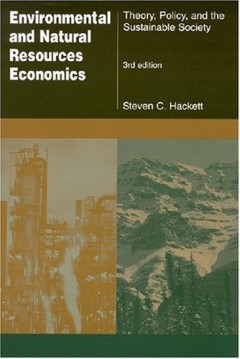
Environmental and natural resources economics: theory, policy, and the sustai…
This new edition of ''Environmental and Natural Resources Economics'' provides an accessible yet rigorous treatment of the subject, including the economics of sustainability. The new edition has been updated extensively throughout. A new chapter has been added on fisheries economics and policy, and the chapter on global climate change has been substantially rewritten to incorporate new scientif…
- Edition
- 3rd ed.
- ISBN/ISSN
- 9780765614728
- Collation
- xxiii, 524 p. : ill. ; 24 cm.
- Series Title
- -
- Call Number
- [TLK-LIB-103]
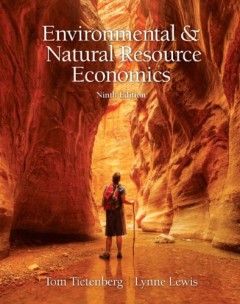
Environmental & natural resource economics
Environmental and Natural Resource Economics takes a policy-oriented approach, introducing economic theory in the context of debates and empirical work from the field. Readers will gain a global perspective of both environmental and natural resource economics.
- Edition
- 9th ed.
- ISBN/ISSN
- 9780131392571
- Collation
- xxviii, 666 p. : ill. ; 24 cm.
- Series Title
- Pearson series in economics
- Call Number
- [TLK-LIB-102]
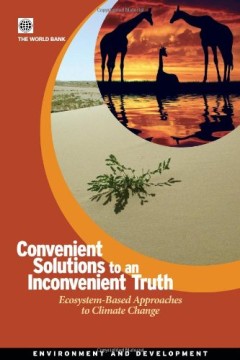
Convenient solutions to an inconvenient truth: ecosystem-based approaches to …
Includes bibliographical references and index.
- Edition
- -
- ISBN/ISSN
- 9780821381267
- Collation
- xii, 114 p. : ill. ; 23 cm.
- Series Title
- Environment and development (Washington, D.C.)
- Call Number
- [TLK-LIB-67]
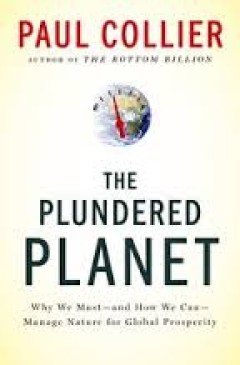
The plundered planet: why we must, and how we can, manage nature for global p…
Paul Collier's The Bottom Billion was greeted as groundbreaking when it appeared in 2007, winning the Estoril Distinguished Book Prize, the Arthur Ross Book Award, and the Lionel Gelber Prize. The Economist wrote that it was "set to become a classic," the Financial Times praised it as "rich in both analysis and recommendations," while Nicholas Kristof of the New York Times called it the "best n…
- Edition
- -
- ISBN/ISSN
- 9780195395259
- Collation
- xv, 271 p. ; 22 cm.
- Series Title
- -
- Call Number
- [POL-LIB-430]
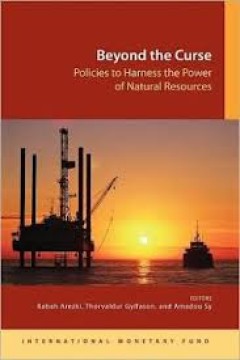
Beyond the curse: policies to harness the power of natural resources
editors, Rabah Arezki, Thorvaldur Gylfason, and Amadou Sy.
- Edition
- -
- ISBN/ISSN
- 9781616351458
- Collation
- xi, 275 p. ; 23 cm.
- Series Title
- -
- Call Number
- [POL-LIB-428]
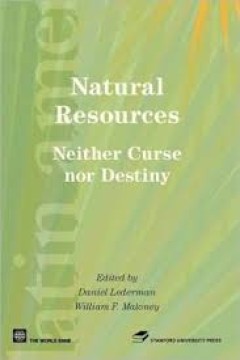
Natural resources, neither curse nor destiny
Customers in the US and Canada please order from Stanford University Press at (800) 621-2736 or visit their website at www.sup.org. 'Natural Resources: Neither Course nor Destiny' brings together a variety of analytical perspectives, ranging from econometric analyses of economic growth to historical studies of successful development experiences in countries with abundant natural resources. The …
- Edition
- -
- ISBN/ISSN
- 9780821365458
- Collation
- xx, 369 p. : ill. ; 23 cm.
- Series Title
- Latin America development forum
- Call Number
- [POL-LIB-424]
 Computer Science, Information & General Works
  Philosophy & Psychology
  Religion
  Social Sciences
  Language
  Pure Science
  Applied Sciences
  Art & Recreation
  Literature
  History & Geography