Computer File
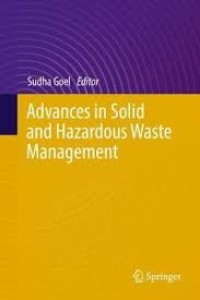
Advances in solid and hazardous waste management
This book presents reviews, examples and case studies of innovative applications in solid and hazardous waste management. The economics of waste management have since become a significant research area in their own right, and two chapters address these issues. In addition, dedicated chapters cover specific categories of waste such as biomedical and institutional waste, plastics and e-waste. The book subsequently discusses newer analytical methods like SEM, EDX, XRD and optical microscopy, along with selected “older” methods for sampling and characterizing different types of waste. The various applications of mathematical tools like linear optimization, various software/models like WISCLeach, and DRASTIC, and tools like remote sensing and GIS are illustrated in many of the chapters. Lastly, since composting is one of the most popular treatment methods for managing the organic component of municipal solid waste, the book provides an overview of composting and the fundamentals of microbiology that are essential to understanding waste-related biological processes. The book was primarily written for students and practitioners in the field who are already familiar with the basics. All chapters were prepared by practicing experts and scholars in the field, and are intended to help readers better understand and apply these principles and practices in their own endeavours. Key topics covered in the book: • The circular economy and the economics of solid waste management • Various remote sensing and GIS applications for managing municipal solid waste, coal fires in mines, changes in land use and land cover in industrial areas, etc. • Treatment and management of different types of solid waste: institutional (including biomedical), residential, e-waste, plastic, and ash from thermal power plants • Sampling and characterization of municipal waste and compost • Fundamentals of microbiology • Overview of environmental regulations, especially those pertaining to solid and hazardous waste management. Read more...
Abstract: This book presents reviews, examples and case studies of innovative applications in solid and hazardous waste management. The economics of waste management have since become a significant research area in their own right, and two chapters address these issues. In addition, dedicated chapters cover specific categories of waste such as biomedical and institutional waste, plastics and e-waste. The book subsequently discusses newer analytical methods like SEM, EDX, XRD and optical microscopy, along with selected “older” methods for sampling and characterizing different types of waste. The various applications of mathematical tools like linear optimization, various software/models like WISCLeach, and DRASTIC, and tools like remote sensing and GIS are illustrated in many of the chapters. Lastly, since composting is one of the most popular treatment methods for managing the organic component of municipal solid waste, the book provides an overview of composting and the fundamentals of microbiology that are essential to understanding waste-related biological processes. The book was primarily written for students and practitioners in the field who are already familiar with the basics. All chapters were prepared by practicing experts and scholars in the field, and are intended to help readers better understand and apply these principles and practices in their own endeavours. Key topics covered in the book: • The circular economy and the economics of solid waste management • Various remote sensing and GIS applications for managing municipal solid waste, coal fires in mines, changes in land use and land cover in industrial areas, etc. • Treatment and management of different types of solid waste: institutional (including biomedical), residential, e-waste, plastic, and ash from thermal power plants • Sampling and characterization of municipal waste and compost • Fundamentals of microbiology • Overview of environmental regulations, especially those pertaining to solid and hazardous waste management
Availability
Detail Information
- Series Title
-
-
- Call Number
-
[TLK-LIB-167]
- Publisher
- nyu : Springer., 2017
- Collation
-
pages cm
- Language
-
English
- ISBN/ISSN
-
9783319570747
- Classification
-
-
- Content Type
-
-
- Media Type
-
-
- Carrier Type
-
-
- Edition
-
-
- Subject(s)
- Specific Detail Info
-
-
- Statement of Responsibility
-
-
Other version/related
No other version available
File Attachment
Comments
You must be logged in to post a comment
 Computer Science, Information & General Works
  Philosophy & Psychology
  Religion
  Social Sciences
  Language
  Pure Science
  Applied Sciences
  Art & Recreation
  Literature
  History & Geography