Filter by
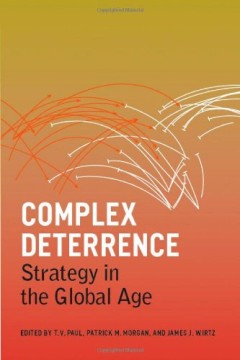
Complex deterrence : strategy in the global age
As the costs of a preemptive foreign policy in Iraq have become clear, strategies such as containment and deterrence have been gaining currency among policy makers. This comprehensive book offers an agenda for the contemporary practice of deterrence--especially as it applies to nuclear weapons--in an increasingly heterogeneous global and political setting. Moving beyond the precepts of traditio…
- Edition
- -
- ISBN/ISSN
- 9780226650029
- Collation
- 1 online resource (x, 345 p.) : ill.
- Series Title
- -
- Call Number
- [POL-SSS-11]

Breaking the phalanx : a new design for landpower in the 21st century
This work proposes the reorganization of America's ground forces on the strategic, operational and tactical levels. Central to the proposal is the simple thesis that the U.S. Army must take control of its future by exploiting the emerging revolution in military affairs. The analysis argues that a new Army warfighting organization will not only be more deployable and effective in Joint operation…
- Edition
- -
- ISBN/ISSN
- 0275957934
- Collation
- 1 online resource (xvi, 283 p.) : ill., maps.
- Series Title
- -
- Call Number
- [POL-SSS-09]

Beyond security, ethics and violence : war against the other
"Anthony Burke offers an analysis of the historical roots of sovereignty and security, his critique of just war theory, and new essays on strategy, the concept of freedom and US exceptionalism. He pursues searching critical engagements with thinkers such as Giorgio Agamben, Hardt and Negri, Emmanuel Levinas, Carl von Clausewitz, Jean Bethke Elshtain, Michael Walzer, Michel Foucault and William …
- Edition
- -
- ISBN/ISSN
- 0415384648
- Collation
- 1 online resource (xi, 284 p.)
- Series Title
- Routledge advances in international relations and global
- Call Number
- [POL-SSS-08]
Beyond fear : thinking sensibly about security in an uncertain world
Explains in detail, for example, why we need to design security systems that don't just work well, but fail well, and why secrecy on the part of government often undermines security.
- Edition
- -
- ISBN/ISSN
- 0387026207
- Collation
- 295 p. ; 24 cm
- Series Title
- -
- Call Number
- [POL-SSS-07]

Alexander the Great : lessons in strategy
Offers a strategic analysis of one of the military careers in history, identifying the most pertinent strategic lessons from the campaigns of Alexander the Great.
- Edition
- -
- ISBN/ISSN
- 9780415358477
- Collation
- 192 p. : ill., map ; 25 cm.
- Series Title
- Cass series--strategy and history, 22.
- Call Number
- [POL-SSS-06]

After hegemony : cooperation and discord in the world political economy
Examines the current state of international politics and economics, discusses theories of rational cooperation, and considers the importance of institutions.
- Edition
- -
- ISBN/ISSN
- 0691076766
- Collation
- ix, 290 p. ; 24 cm.
- Series Title
- -
- Call Number
- [POL-SSS-05]

A purchasing manager's guide to strategic proactive procurement
Details the latest innovations in purchasing and supply management, and the trend in purchasing departments from reactive to proactive status. Case studies show how to add value at the four key stages, how to determine what to buy, and how to integrate the purchasing function with TQM.
- Edition
- -
- ISBN/ISSN
- 0814402887
- Collation
- 1 online resource (xvi, 319 p.) : ill., maps.
- Series Title
- -
- Call Number
- [POL-SSS-04]
A global security triangle : European, African and Asian interaction
The urgency attached to the agenda of international terrorism and human and drug-trafficking has forced the EU into new cooperation with Africa and Asia. The EU has developed various strategies towards Africa and the Asian regions. This book provides conceptual and empirical arguments to offer a fresh perspective on the EU as a global actor.
- Edition
- -
- ISBN/ISSN
- 0415496578
- Collation
- xx, 256 p. : ill. ; 24 cm
- Series Title
- Routledge/GARNET series., Europe in the world.
- Call Number
- [POL-SSS-03]
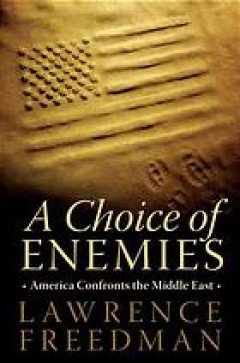
A choice of enemies : America confronts the Middle East
Examines how the Camp David summit leading to the Israel-Egypt Treaty, the Iranian Islamic revolution, and the failed Soviet intervention in Afganistan all influenced America's strategic and policy choices and led to its current involvement in the MiddleEast.
- Edition
- 1st ed
- ISBN/ISSN
- 9781586485184
- Collation
- xxviii, 601 p. : maps ; 24 cm
- Series Title
- -
- Call Number
- [POL-SSS-01]

What moves man : the realist theory of international relations and its judgme…
The realist theory of international relations is based on a particularly gloomy set of assumptions about universal human motives. Believing people to be essentially asocial, selfish, and untrustworthy, realism counsels a politics of distrust and competition in the international arena. What Moves Man subjects realism to a broad and deep critique. Freyberg-Inan argues, first, that realist psychol…
- Edition
- -
- ISBN/ISSN
- 079145827X
- Collation
- vi, 266 p. ; 23 cm
- Series Title
- SUNY series in global politics
- Call Number
- [POL-IRT-72]
 Computer Science, Information & General Works
 Philosophy & Psychology
 Religion
 Social Sciences
 Language
 Pure Science
 Applied Sciences
 Art & Recreation
 Literature
 History & Geography