Filter by

Democracy and democratization: processes and prospects in a changing world
What is democracy? What are the pitfalls and the positive potentials in the growing trend toward democratization? This book examines the prospects for democracy in the world today and frames the central dilemma confronting all states touched by the process of democratization. Georg S?rensen clarifies the concept of democracy, shows its application in different contexts, and questions whether de…
- Edition
- 3rd ed.
- ISBN/ISSN
- 9780813343808
- Collation
- xiv, 203 p. : ill. ; 23 cm.
- Series Title
- Dilemmas in world politics
- Call Number
- [POL-LIB-486]

The state of democratic theory
this book gets rid of the flavour of ideology and focuses on the actual workings of democracy in real life. The idea that democracy is simply a system of checks and balances is well developed by the author as he describes it as a system 'to avoid domination of one class or sector on others.
- Edition
- -
- ISBN/ISSN
- 9780691115474
- Collation
- xi, 183 p. ; 24 cm.
- Series Title
- -
- Call Number
- [POL-LIB-485]

Democracy and coercive diplomacy
Schultz explores the effects of democratic politics on coercive diplomacy. He argues that open political competition between government and opposition parties influences threats in international crises, how rival states interpret those threats, and whether or not crises can be settled short of war. Compared to their nondemocratic counterparts, democracies make threats more selectively, but thos…
- Edition
- -
- ISBN/ISSN
- 9780521792271
- Collation
- xv, 301 p. : ill. ; 24 cm.
- Series Title
- Cambridge studies in international relations ; 76
- Call Number
- [POL-LIB-484]

Modernization, cultural change, and democracy: the human development sequence
This book demonstrates that people's basic values and beliefs are changing, in ways that affect their political, sexual, economic, and religious behavior. These changes are roughly predictable because they can be interpreted on the basis of a revised version of modernization theory presented here. Drawing on a massive body of evidence from societies containing 85% of the world's population, the…
- Edition
- -
- ISBN/ISSN
- 9780521846950
- Collation
- x, 333 p. : ill. ; 24 cm.
- Series Title
- -
- Call Number
- [POL-LIB-483]

Democracy from above: regional organizations and democratization
Few scholars have systematically examined whether the world outside a state's borders can influence the prospects for democracy. Jon Pevehouse argues that regional organizations, such as the European Union and the Organization of American States, can have an important role in both the transition to, and the longevity of, democracy. Combining statistical analysis and case study evidence, Pevehou…
- Edition
- -
- ISBN/ISSN
- 9780521844826
- Collation
- xiv, 248 p. : ill. ; 24 cm.
- Series Title
- -
- Call Number
- [POL-LIB-481]

Economic crises and the breakdown of authoritarian regimes: Indonesia and Mal…
Why do some authoritarian regimes topple during financial crises, while others steer through financial crises relatively unscathed? In this book, Thomas B. Pepinsky uses the experiences of Indonesia and Malaysia and the analytical tools of open economy macroeconomics to answer this question. Focusing on the economic interests of authoritarian regimes' supporters, Pepinsky shows that differences…
- Edition
- -
- ISBN/ISSN
- 9780521744386
- Collation
- xviii, 326 p. : ill. ; 23 cm.
- Series Title
- -
- Call Number
- [POL-LIB-480]

Carbon democracy: political power in the age of oil
- Edition
- -
- ISBN/ISSN
- 9781844677450
- Collation
- 278 p. : maps ; 24 cm.
- Series Title
- -
- Call Number
- [POL-LIB-479]
- Edition
- -
- ISBN/ISSN
- 9781844677450
- Collation
- 278 p. : maps ; 24 cm.
- Series Title
- -
- Call Number
- [POL-LIB-479]
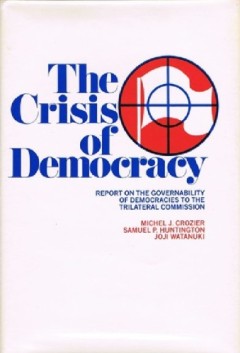
The crisis of democracy: report on the governability of democracies to the Tr…
- Edition
- -
- ISBN/ISSN
- 0814713645
- Collation
- 220 p. ; 21 cm.
- Series Title
- The Triangle papers ; [8]
- Call Number
- [POL-LIB-478]
- Edition
- -
- ISBN/ISSN
- 0814713645
- Collation
- 220 p. ; 21 cm.
- Series Title
- The Triangle papers ; [8]
- Call Number
- [POL-LIB-478]

Democracy, America, and the age of globalization
- Edition
- -
- ISBN/ISSN
- 9780521885898
- Collation
- xi, 163 p. ; 23 cm.
- Series Title
- -
- Call Number
- [POL-LIB-477]
- Edition
- -
- ISBN/ISSN
- 9780521885898
- Collation
- xi, 163 p. ; 23 cm.
- Series Title
- -
- Call Number
- [POL-LIB-477]

Democracy by force: U.S. military intervention in the post-Cold War world
Since the end of the Cold War the United States has intervened militarily in a number of civil conflicts around the world, with varying degrees of success. This book examines four US-sponsored interventions (Panama, Somalia, Haiti and Bosnia), focusing on the vital nation-building efforts which have followed military action. The book seeks to provide a greater understanding of the successes and…
- Edition
- -
- ISBN/ISSN
- 9780521650519
- Collation
- xii, 224 p. : ill., maps ; 24 cm.
- Series Title
- -
- Call Number
- [POL-LIB-476]
 Computer Science, Information & General Works
  Philosophy & Psychology
  Religion
  Social Sciences
  Language
  Pure Science
  Applied Sciences
  Art & Recreation
  Literature
  History & Geography