Filter by
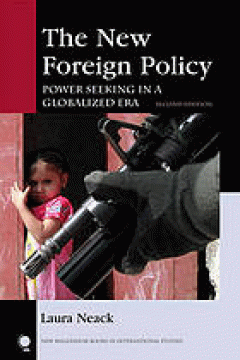
The new foreign policy: power seeking in a globalized era
In this cogent text, Laura Neack argues that foreign policy making in this uncertain era of globalization and American global hegemony revolves around seeking and maintaining power
- Edition
- 2nd ed.
- ISBN/ISSN
- 9780742556317
- Collation
- xv, 233 p. : ill. ; 23 cm.
- Series Title
- New millennium books in international studies
- Call Number
- [POL-LIB-569]

Foreign policy in global information space: actualizing soft power
This book aims to explain how foreign policy can adapt to the challenge of globalization. Two central questions are posed to structure the argument such as: how can foreign policy defend or project statist political communities using soft power within a global information space, and does soft power, when exercised in turn by non-state actors, affect foreign policy by undermining statist communi…
- Edition
- -
- ISBN/ISSN
- 9781403975201
- Collation
- xiii, 240 p. : ill ; 24 cm.
- Series Title
- -
- Call Number
- [POL-LIB-568]
Global energy governance: the new rules of the game
Analyzes the energy market from an institutionalist perspective and offers practical policy recommendations to deal with these challenges. This book presents perspectives on how regulatory institutions can ensure reliable sources of energy, evaluate financial risk, and provide emergency response mechanisms to deal with interruptions in supply.
- Edition
- -
- ISBN/ISSN
- 9780815703433
- Collation
- xi, 372 p. : ill., maps ; 23 cm.
- Series Title
- -
- Call Number
- [POL-LIB-559]

Fathers of international thought : the legacy of political theory
- Edition
- -
- ISBN/ISSN
- 9780585300122
- Collation
- 1 online resource (xi, 144 pages)
- Series Title
- -
- Call Number
- [POL-LIB-554]
- Edition
- -
- ISBN/ISSN
- 9780585300122
- Collation
- 1 online resource (xi, 144 pages)
- Series Title
- -
- Call Number
- [POL-LIB-554]
Globalization and national security
In this book, top scholars of international relations assess the consequences of globalization for national security, identifying three distinct ‘processes’ of globalization - the intensification of economic exchange, the flow of information, and marketization (the expansion of the set of social relations governed by market forces)-exploring how they can affect the capacity and power of sta…
- Edition
- -
- ISBN/ISSN
- 9780415955119
- Collation
- v, 361 p. ; 23 cm.
- Series Title
- -
- Call Number
- [POL-LIB-546]
Globalization: a critical introduction
This is a systematically revised and updated new edition of a highly-acclaimed text which was an immediate bestseller on courses around the world. The second edition takes a broader perspective giving increased coverage of other dimensions of globalization alongside its core focus on the rise of supraterritoriality which the author argues is globalization's most distinctive feature.
- Edition
- 2nd ed.
- ISBN/ISSN
- 9780333977026
- Collation
- xxv, 492 p. ; 24 cm.
- Series Title
- -
- Call Number
- [POL-LIB-543]
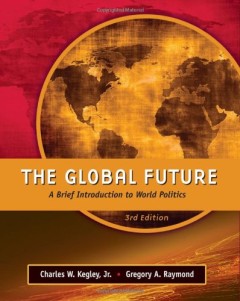
The global future: a brief introduction to world politics
Charles W. Kegley, Jr., Gregory A. Raymond.
- Edition
- 3rd ed.
- ISBN/ISSN
- 9780495569275
- Collation
- xxii, 453 p. : ill., maps ; 24 cm.
- Series Title
- -
- Call Number
- [POL-LIB-537]
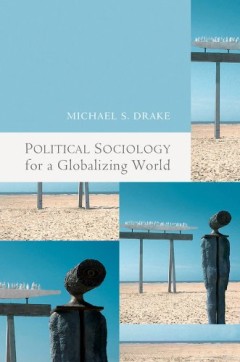
Political sociology for a globalizing world
This book addresses one of the twenty-first century's most important issues: the increasing lack of connection between political institutions and the social reality of our everyday lives. A gulf between popular expectations and formal politics has widened continually since the revolts against authority of 1968, the Eastern European revolutions of 1989 and the growth of new social movements. Tod…
- Edition
- -
- ISBN/ISSN
- 9780745638270
- Collation
- viii, 232 pages ; 23 cm
- Series Title
- -
- Call Number
- [POL-LIB-499]
Critical theories, international relations and 'the anti-globalisation moveme…
"This book explores the interface between diverse social movement resistances to neoliberal globalisation and a range of critical theories in the discipline of International Relations (IR). The book is a powerful contribution to what the editors hope will be an ongoing dialogue between "the movement" and IR, between theory and practice, and between different critical theory perspectives."--BOOK…
- Edition
- -
- ISBN/ISSN
- 0415343909
- Collation
- xviii, 264 p. ; 24 cm.
- Series Title
- RIPE series in global political economy
- Call Number
- [POL-LIB-213]
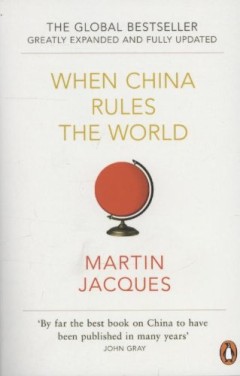
When China Rules the World: The Rise of the Middle Kingdom and the End of the…
China will replace the United States as the world's dominant power. In so doing, it will not become more western but the world will become more Chinese. Jacques argues that we cannot understand China in western terms but only through its own history and culture. To this end, he introduces a powerful set of ideas including China as a civilization-state, the tributary system, the Chinese idea of …
- Edition
- -
- ISBN/ISSN
- 0140276041
- Collation
- 848 pages
- Series Title
- -
- Call Number
- [POL-LIB-209]
 Computer Science, Information & General Works
  Philosophy & Psychology
  Religion
  Social Sciences
  Language
  Pure Science
  Applied Sciences
  Art & Recreation
  Literature
  History & Geography