Computer File
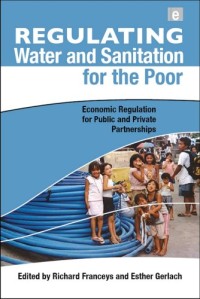
Regulating water and sanitation for the poor: economic regulation for public and private partnerships
The aim of this book is to present the potential benefits as well as the challenges of introducing a more formal economic regulatory process into the urban water sector arena in lower-income countries. There is a particular focus upon the impact this may have on the poorest, the informal, slum and shanty dwellers of the rapidly growing cities. Economic regulation, usually introduced in the context of private operation of monopoly water supply, can deliver objectivity and transparency in the price-setting process for public providers also. But this is not, as is commonly assumed, primarily to protect the customer from the provider; rather it is to allow the service provider to set something approaching cost-reflective tariffs. These charges, almost certainly higher than previously, perversely can benefit the poor who have been paying far more for informal access to any piped supplies. With the addition of a regulatory duty to achieve some form of adaptive Universal Service Obligation, economic regulation could contribute significantly to the achievement of the Millennium Development Goals in urban areas.The book describes and analyzes these issues through a consideration of ten country case studies. As a starting point, the current situation for the provision of water and sanitation services for the poorest through non-regulated public providers in India and Uganda is reviewed. Comparative chapters are then presented on Argentina, Ghana, Philippines, Bolivia, Jordan, Zambia and Indonesia, all with varying degrees of private sector involvement and regulation. Finally, the experiences of the two richest countries, Chile and England, are considered, investigating service to the poor in these examples with the longest experience of economic regulation and the “most privatized” suppliers. In all cases there is a focus on the very necessary role of customer involvement in price-setting and service monitoring and on the role of alternative (private) service providers within the context of the need for least cost utility service provision to all.
Availability
Detail Information
- Series Title
-
-
- Call Number
-
[TLK-LIB-208]
- Publisher
- enk : Earthscan., 2008
- Collation
-
xviii, 286 p. : ill. ; 25 cm.
- Language
-
English
- ISBN/ISSN
-
9781844076178
- Classification
-
HD4465.D44 R44 2008
- Content Type
-
-
- Media Type
-
-
- Carrier Type
-
-
- Edition
-
-
- Subject(s)
- Specific Detail Info
-
-
- Statement of Responsibility
-
-
Other version/related
No other version available
File Attachment
Comments
You must be logged in to post a comment
 Computer Science, Information & General Works
  Philosophy & Psychology
  Religion
  Social Sciences
  Language
  Pure Science
  Applied Sciences
  Art & Recreation
  Literature
  History & Geography